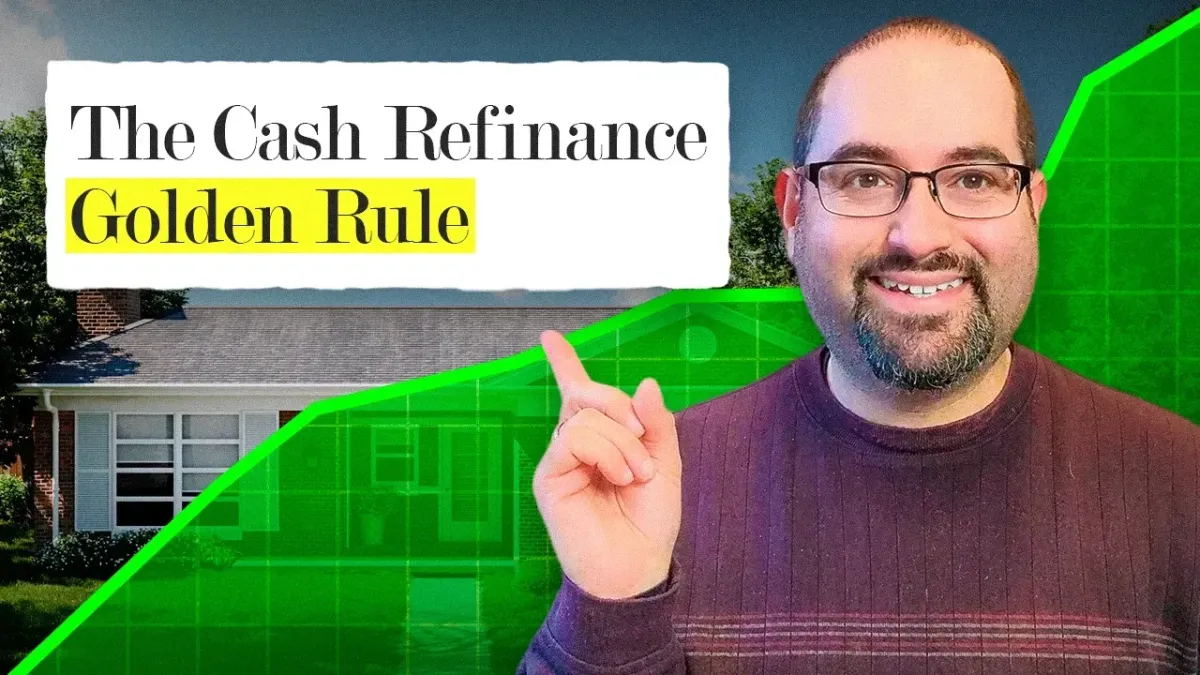
You're thinking about cash-out refinancing completely backwards
The one rule that separates wealth builders from expensive mistakes
You've got equity sitting in your property right now.
It feels like safety. It feels like progress.
But what is it actually doing for you?
The hard truth? Nothing. It's just sitting there. Locked inside the walls. Earning zero.
And the way most investors think about pulling it out? That's where the real danger starts.
THE WRONG QUESTION EVERYONE ASKS
Most investors approach a cash-out refi by asking one question: "What can I use this money for?"
It sounds reasonable. It's completely wrong.
That question leads you straight into trouble. The answer is almost anything, and that's exactly the problem.
Without a real decision framework, you're just guessing. And guessing with your equity is expensive.
There's one rule that changes everything. Wealthy investors follow it every time. Investors who get burned ignore it every time.
YOUR EQUITY HAS A RETURN RATE (AND IT'S ZERO)
Here's the idea that makes everything click.
Say your rental property is worth $400,000 and you owe $200,000. You've got $200,000 in equity on paper.
That feels good. But ask yourself honestly: what is that $200,000 earning you right now?
Nothing. Zero. It doesn't generate cash flow. It doesn't compound. It just sits still.
And here's the part that trips people up. Your property appreciates regardless of how much equity is trapped inside it. The appreciation happens on the property value, not on your equity position.
A giant pile of equity doesn't make your property grow faster. It just means you've got a big chunk of dead money doing nothing.
Stop thinking of trapped equity as safety. Start thinking of it as lazy money.
THE COST NOBODY CALCULATES
Pulling equity out isn't free. Most investors completely miss this part.
There are two real costs buried in every cash-out refi.
Closing costs upfront: lender fees, title, appraisal. On an investment property this runs thousands of dollars.
A higher rate on your entire balance: not just on the money you pulled out, but on everything you owe.
So if it costs you 7% to access that equity, whatever you put that money into has to earn more than 7%. That's the spread. That's the whole game.
If you redeploy into a rental earning 11%, you win. You cleared the spread.
If you spend it on a car or a vacation earning zero, you lose. You can't win that math.
THE RESET TRAP (THE SNEAKY ONE)
There's one more hidden cost that gets even smart investors.
When you refinance, you usually restart a fresh 30-year loan term. If you were eight years into your current mortgage, you just erased eight years of amortization progress.
At the start of a mortgage, almost every payment goes to interest. Barely any goes to principal. You've reset the clock back to the beginning.
Here's the trap. Sometimes investors get a lower rate and feel like they won. But if you reset an eight-year-old loan back to 30 years, you can end up paying more total interest even at a lower rate. The rate dropped, but the total cost went up.
Always count the reset. Always add it to the full picture alongside closing costs and the higher balance.
WATCH THIS BEFORE YOU TOUCH YOUR EQUITY
This video lays out the one rule, the real cost equation, and exactly how to run the test on your own deals before you make a move.
If you've got equity right now and you're wondering whether pulling it out actually makes sense, this is your next watch.
P.S. If you want someone to run the numbers on your specific deal and tell you straight whether it works, don't wait.
Talk soon,
Robert Weinberg


