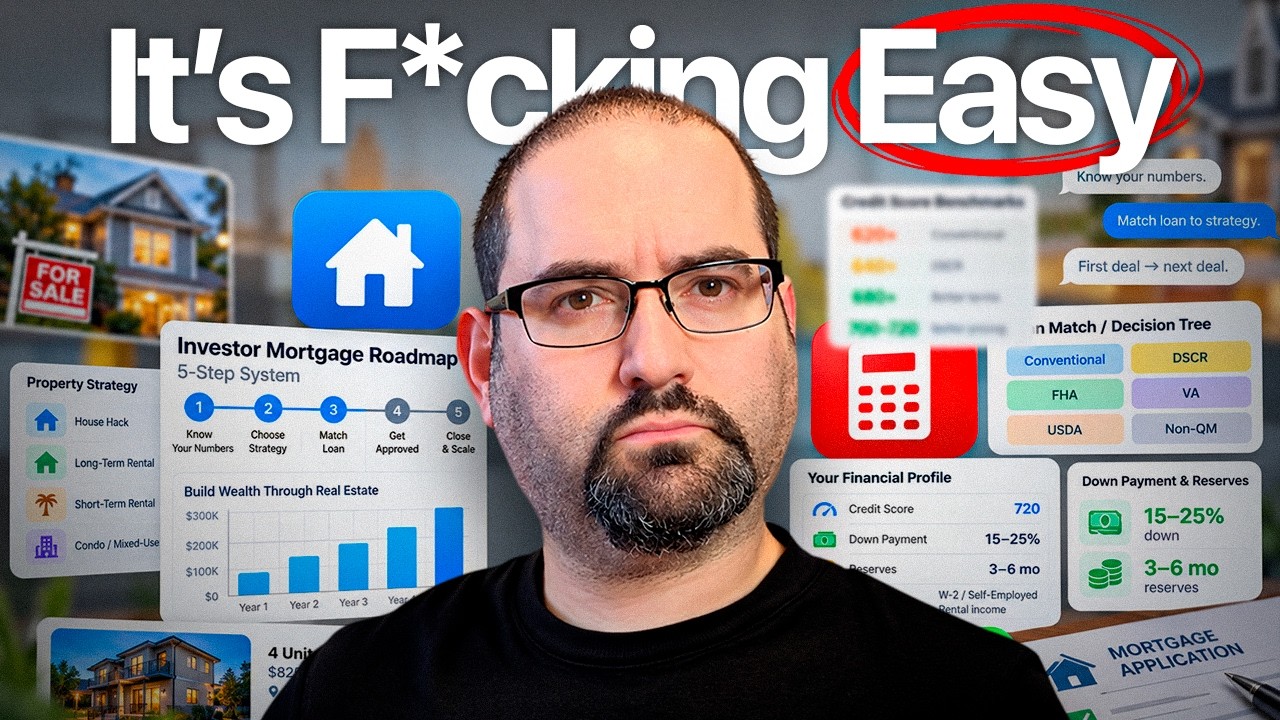
Why smart investors stop asking "which loan?" and start asking this instead
The 5-step system that removes all the guesswork
Most mortgage content is useless.
Not because it's wrong. Because it gives you a list and tells you to figure it out yourself. That's not guidance. That's a doctor handing you a pharmacy catalog and wishing you luck.
You deserve better than that.
YOUR FINANCIAL PROFILE COMES FIRST
Before you look at a single property, you need to know where you actually stand. And most investors only look at one or two of the four variables that actually matter.
Here's what your profile is really made of:
Your mortgage FICO scores (not Credit Karma, not your credit card app - the real number at myfico.com)
Your available down payment capital
Your reserves after closing costs are covered
Your income documentation type
That last one determines entire categories of loans that are either open or completely closed to you. And reserves? That's the variable that kills more deals than almost anything else. People budget for the down payment. They forget what needs to be left over.
YOUR PROPERTY TYPE NARROWS THE FIELD BEFORE YOUR FINANCES DO
Most videos treat property type as a footnote. It's actually the first filter.
House hacking a duplex or fourplex? FHA, VA, even USDA may be on the table with as little as zero down. Pure investment property you'll never live in? FHA, VA, and USDA disappear entirely. Planning a short-term rental? Many lenders won't touch it, or they'll undervalue the income significantly.
Know your strategy before you talk to anyone. Several loan types eliminate themselves the moment you get clear on this.
THE DECISION TREE THAT POINTS TO YOUR LOAN
Once you know your profile and your property type, the right loan practically reveals itself. You don't need to guess.
Living in the property? Conventional, FHA, VA, and USDA all come into play depending on your credit and eligibility. Not living in it? You're choosing between conventional investment loans and DSCR.
Here's what almost nobody tells you about DSCR loans closed inside an LLC: that mortgage does not show up on your personal credit report. Your personal debt-to-income ratio stays completely clean. That matters enormously when you want to buy property two, three, and four without your personal borrowing power getting crushed.
THE THRESHOLDS THAT CONTROL YOUR RATE
Your interest rate doesn't improve gradually. It moves in cliffs.
On DSCR loans, pricing tiers sit at credit scores of 640, 680, 700, 720, and 740. A jump from 699 to 700 can drop your rate enough to turn a break-even deal into one that cash flows. On a $300,000 loan, a quarter-point difference is roughly $50 a month, or $18,000 over 30 years.
Down payment thresholds work the same way. At 25% down versus 20%, your rate improves, your lender options expand, and your DSCR ratio gets easier to hit. Small moves. Disproportionate results.
Always ask your lender: "What would it take to move to the next pricing tier?"
DEAL ONE IS REALLY ABOUT DEAL THREE
The loan you choose today has consequences that ripple forward. Conventional loans stack against your personal DTI with every property. By deal four or five, lenders start pushing back, even when every property cash flows.
DSCR loans in an LLC don't accumulate that drag. Each deal stands alone. Your personal borrowing power stays intact deal after deal.
The investors who build real portfolios think three deals ahead, even on deal one.
WATCH THE FULL BREAKDOWN
This five-step system is all in one place. Financial profile. Property type. Loan matching. Pricing thresholds. Portfolio strategy. Watch it now and walk away knowing exactly what loan fits your situation.
P.S. If you have a deal in front of you right now, don't guess on the numbers.
To your next deal,
Robert Weinberg


